5. Technical Analysis
5.1 Principal strengths
The extraction system has four important strengths. First, it is operationally stable: nearly all source records can be matched and evaluated. Second, weighted precision is high across most datasets and core segments, indicating that extracted facts are generally grounded in the PDF. Third, unsupported-content rates are low for Experience, Profile, Skills, Education, Certifications, and Languages. Fourth, local execution provides data-control advantages for sensitive CV data because documents need not be transmitted to a third-party inference service.
The combination of a conservative verbatim-copying prompt, a multilingual instruction model, quantization-aware training, and explicit output formatting appears well suited to high-precision extraction. The model is also computationally attractive relative to a dense 26B model because only approximately 3.8B parameters are active per token, although all expert weights still contribute to memory requirements [4].
5.2 Principal weaknesses
The dominant weakness is information loss. Weighted recall of 65.5% and completeness of 68.2% mean that a substantial proportion of source facts is unavailable in the structured index. This is particularly serious for candidate search because false negatives can remove qualified candidates from retrieval. The weakness is not confined to optional metadata; Education, Certifications, Languages, and Skills all show material omission.
A second weakness is the unreliability of derived or classification-heavy fields. Seniority, normalized fields, category classification, and document metadata have low F1 and, in several cases, high unsupported-content rates. These fields require deterministic derivation or source validation. A third weakness is occupational heterogeneity: the same model and prompt behave very differently across datasets, so a global acceptance score cannot guarantee performance on a particular recruitment domain.
5.3 Ontological ambiguity between experience and skills
CV information is not naturally partitioned into mutually exclusive database columns. An employment bullet may simultaneously identify a role, describe a task, demonstrate a skill, name a tool, and provide evidence of seniority. A dedicated skills list is only one possible surface form of competency evidence. Treating Experience and Skills as binary alternatives therefore introduces label noise: two evaluators can agree on the source fact and still disagree on the single field to which it should belong.
For extraction evaluation, this ambiguity can produce apparent segmentation errors even when the verbatim fact has been recovered. A technically stronger representation assigns each source span a primary structural location plus zero or more semantic roles. The system can then score factual recovery separately from field-role assignment. Overlap-compatible matches should receive full or partial credit according to an explicit adjudication rule, while genuinely unrelated placements should remain errors.
For retrieval, the same-context requirement should consequently be implemented as typed compatibility rather than strict equality. A skill criterion may be satisfied by an explicit Skills entry or by an experience statement that directly demonstrates the skill. It should not be satisfied by a hobby keyword or an unrelated course title unless the application explicitly accepts those evidence types. This multi-label approach improves recall without abandoning evidentiary discipline.
The practical data model should retain the original source span once, associate it with a structural section and multiple semantic role tags, and preserve page or character provenance. Downstream search can then choose the permitted evidence roles for each job criterion instead of depending on a brittle one-field classification made during extraction.
5.4 Why high precision and low recall coexist
The observed precision-recall profile is consistent with a conservative extraction objective. The prompt forbids rewriting, normalization, correction, and translation and demands that text be copied only when it clearly belongs to a requested headline. When section boundaries are ambiguous, the lower-risk behavior is to return an empty or incomplete block. This protects precision but creates omissions. Reasoning-disabled inference may reinforce this behavior by reducing the model capacity used for cross-section reconciliation and ambiguous classification, although the present data cannot isolate that causal effect.
The XML block contract also decomposes the task by requested headline. Facts that span multiple source sections, such as a technology mentioned only inside a job responsibility, can be missed if the corresponding headline definition is narrow. Similarly, tables, sidebars, multi-column layouts, and repeated headings can make a text-only section assignment brittle even when the model understands the content.
5.5 Schema completeness is not factual completeness
The weak correlation between schema completeness and weighted F1 is a critical systems result. Schema validators verify shape, presence, and type; they do not verify that values are supported by the source. A production pipeline can therefore pass JSON schema validation while still omitting important facts or containing unsupported normalized values. Validation must be layered: syntactic validation, semantic field validation, source-evidence validation, and retrieval-behavior validation.
For RAG, this means that database completeness cannot be inferred from non-null fields. A generic value can make a field appear complete while reducing specificity. Conversely, an empty field may reflect extraction failure rather than source absence. Indexing and ranking logic must preserve this uncertainty.
5.6 Consequences for retrieval and ranking
The extracted JSON is suitable for positive-evidence retrieval but unsuitable for hard negative filtering. A query such as "must speak German" may retrieve candidates whose structured language field contains German. It must not automatically exclude all other candidates, because the language segment has only 50.3% completeness. The system should search explicit structured fields first, then search compatible evidence roles, and finally execute a raw-section or full-text fallback for candidates with missing or low-confidence fields.
Ranking should also distinguish evidence strength. A skill listed in a dedicated Skills section, repeated in recent professional experience, and supported by a source excerpt should score more highly than a single uncontextualized keyword. Derived seniority labels should not override dated employment evidence. Category classification should be treated as a navigation aid or weak feature, not a definitive occupational label.
5.7 Decomposing low coverage: source absence versus extraction failure
The term low coverage is ambiguous unless the analysis separates information that is absent from the source CV from information that is present in the PDF but not recovered by the extraction model. These mechanisms have different causes and different consequences. Source-limited coverage is a property of the corpus and should not be scored as model failure. Extraction-limited coverage is a false-negative problem: relevant evidence exists, but the structured representation omits it.
At document-segment level, a CV is applicable when the PDF contains at least one fact belonging to the segment under the evaluation taxonomy. A non-applicable segment means the CV does not state or support that type of information. By contrast, an applicable but unpopulated segment means that the PDF supported the segment but Gemma returned no value. At atomic-fact level, any omitted PDF-supported fact is a false negative even when the segment contains some other extracted content.
Source availability answers: how often do the CVs legitimately provide information for the segment? It is a corpus property, not an extraction-quality measure.
Conditional population measures whether Gemma produced at least one value when the PDF made the segment applicable. This is useful but lenient: one extracted item can make a segment non-empty while many supported facts remain omitted.
Here Qs denotes partially correct facts. Atomic-fact completeness is the preferred measure of how much PDF-supported information Gemma recovered. Weighted recall is stricter because it awards only half credit to partial facts.
| Segment | Applicable CVs | Source availability | Gemma populated when applicable | PDF-supported facts | Gemma completeness | Weighted recall |
|---|---|---|---|---|---|---|
| Experience | 2,482 | 100.0% | 96.1% | 108,474 | 85.3% | 81.8% |
| Skills | 2,473 | 99.6% | 95.6% | 81,804 | 66.0% | 64.1% |
| Education | 2,462 | 99.2% | 96.0% | 12,275 | 60.5% | 56.7% |
| Profile | 2,444 | 98.5% | 91.3% | 15,667 | 79.1% | 75.2% |
| Seniority | 2,252 | 90.7% | 11.8% | 7,743 | 3.1% | 2.4% |
| Certifications | 1,147 | 46.2% | 83.2% | 5,088 | 55.9% | 51.1% |
| Languages | 451 | 18.2% | 94.7% | 1,737 | 50.3% | 45.8% |
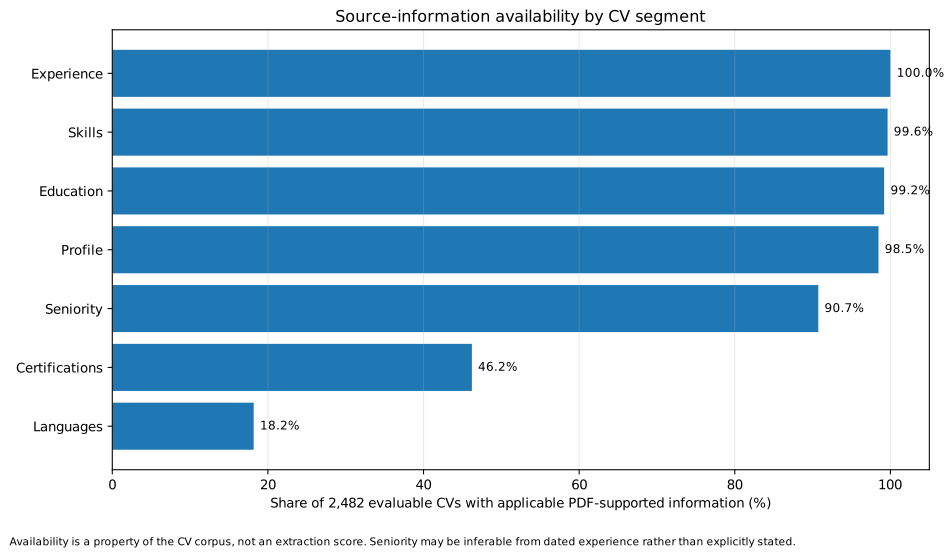
Source: aggregated 05_Segment_Results worksheets from 24 category reports. Denominator: 2,482 evaluable CVs.
Interpretation. Experience, Skills, Education, and Profile are available in more than 98% of evaluable CVs. Certifications and Languages are intrinsically source-limited. Seniority is frequently inferable from dated experience even when it is not explicitly stated.
Open SVG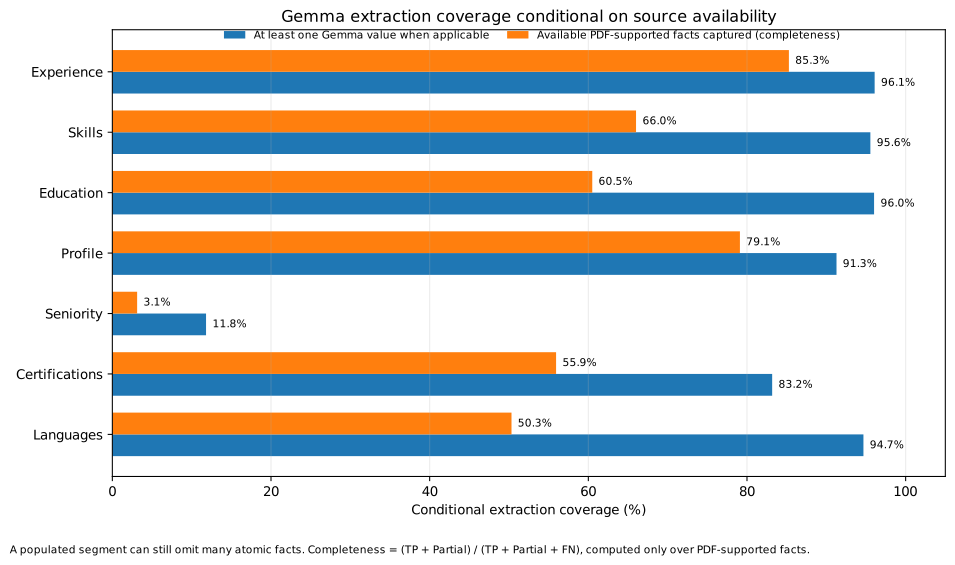
Source: aggregated 05_Segment_Results worksheets from 24 category reports. Completeness = (TP + Partial) / (TP + Partial + FN).
Interpretation. A non-empty segment is not equivalent to complete recovery. Skills is populated in 95.6% of applicable CVs but recovers only 66.0% of PDF-supported facts. Education shows a similar gap. Certifications and Languages combine source sparsity with extraction omissions. Seniority is a derived-field failure and should not be treated as authoritative.
Open SVG5.7.1 What the PDF–ChatGPT–Gemma evidence shows
The 24 category workbooks preserve the three compared evidence layers at atomic-evidence level: the original PDF excerpt or PDF-supported fact, the ChatGPT reference extraction, and the local Gemma extraction. Across the atomic-evidence rows, ChatGPT reference values are populated in approximately 219,982 rows, compared with 157,035 populated Gemma values—about 40% more. Within the evaluation design, this supports a clear coverage conclusion: ChatGPT recovered a materially broader share of the information represented in the source CVs. The pattern is consistent with Gemma’s high false-negative counts and with the large gap between non-empty segments and complete atomic-fact recovery, particularly for skills, education, seniority, normalized fields, and document metadata.
Gemma 4 was served with --reasoning off. The model therefore had to map long, heterogeneous CV text directly into the requested structure without an explicit deliberative pass for coverage planning, cross-section reconciliation, ambiguity resolution, or final self-checking. This configuration favors speed, fewer generated tokens, and predictable structured output, but it also encourages a first-pass extraction pattern in which distributed or weakly signposted evidence is easier to omit. Linking dates to roles and employers, recognizing a skill demonstrated inside an experience bullet, deriving seniority from a career history, and revisiting an unexpectedly empty field all benefit from additional computation. The observed omission-heavy error profile and very weak seniority recovery are therefore consistent with the reasoning-disabled operating condition.
Classification of CV text is not a binary choice. A single sentence can simultaneously encode employment experience, technical or interpersonal skills, project participation, domain knowledge, seniority evidence, tools, responsibilities, and outcomes. A bullet describing leadership of an SAP migration, for example, is both experience and evidence of project-management, ERP, stakeholder, and leadership skills. Forcing that span into exactly one field creates artificial omissions even when the source fact has been recognized. ChatGPT’s broader apparent coverage may partly reflect more inclusive assignment of evidence across overlapping fields, whereas direct extraction can encourage narrower one-field decisions.
For RAG search, the appropriate representation is therefore multi-label rather than mutually exclusive: preserve the source span once, attach a primary semantic role and any compatible secondary roles, record provenance and confidence, and allow retrieval across field-compatible evidence. An experience passage may satisfy a skills query; a project passage may support domain expertise or seniority; and certification text may support both credentials and skills. The three-way evidence supports the practical conclusion that ChatGPT supplied broader candidate coverage, while Gemma’s high-precision but incomplete output should be supplemented with source-span retrieval and multi-label enrichment rather than treated as a complete binary classification of the CV.
For deployment, missing values should be represented with at least three states: not stated in the source, stated but not extracted; extracted with source evidence. Each indexed field should retain source applicability, extraction status, extractor identity, source span, page reference, and confidence. Hard exclusion should be permitted only when source absence has been established, not merely when the Gemma field is empty.