All four reranked conditions exceed Lucene on the four reported macro quality measures.
Corrected current-result edition · 25 July 2026
Measured evaluation of a RAG retrieval benchmark
Dense retrieval, frozen criteria, selective evidence policies, Qwen reranking, and a Lucene custom TF–IDF comparator—examined as an academic benchmark, not accepted as-is.
All three non-reranked RAG conditions fall below Lucene on those macro measures.
Observed additional mean latency for the three matched reranker contrasts.
Case bootstrap intervals do not estimate infrastructure or run-to-run variance.
Measured results
Common-cutoff quality and latency
Every plotted value comes from the current aggregate artifacts and was reconciled with the 208 case rows.
Active comparisonnDCG@10
LuceneRAG, no rerankRAG + rerank
| Condition | P@10 | R@10 | nDCG@10 | MRR | Mean ms | p95 ms |
|---|---|---|---|---|---|---|
| LuceneLUC | 0.523 | 0.407 | 0.619 | 0.837 | 197 | 386 |
| RAG Standard Whole + rerankSTD-WHOLE-RR | 0.550 | 0.409 | 0.666 | 0.942 | 14,291 | 17,576 |
| RAG Standard Criteria, no rerankSTD-CRIT-NO-RR | 0.454 | 0.363 | 0.548 | 0.799 | 1,932 | 2,141 |
| RAG Standard Criteria + rerankSTD-CRIT-RR | 0.577 | 0.446 | 0.697 | 0.942 | 14,469 | 19,823 |
| RAG Selective Whole, no rerankSEL-WHOLE-NO-RR | 0.496 | 0.381 | 0.568 | 0.788 | 1,667 | 1,824 |
| RAG Selective Whole + rerankSEL-WHOLE-RR | 0.565 | 0.429 | 0.681 | 0.962 | 14,093 | 18,719 |
| RAG Selective Criteria, no rerankSEL-CRIT-NO-RR | 0.465 | 0.355 | 0.527 | 0.770 | 1,776 | 2,162 |
| RAG Selective Criteria + rerankSEL-CRIT-RR | 0.573 | 0.437 | 0.689 | 0.923 | 14,289 | 20,243 |
Matched reranker effects
Standard criteria
+0.149 nDCG@10- Case-bootstrap 95% CI
- [0.0557, 0.2526]
- Wins / ties / losses
- 16 / 2 / 8
- Mean latency
- +12.54 s
Selective criteria
+0.162 nDCG@10- Case-bootstrap 95% CI
- [0.0707, 0.2599]
- Wins / ties / losses
- 18 / 1 / 7
- Mean latency
- +12.51 s
Selective whole
+0.113 nDCG@10- Case-bootstrap 95% CI
- [0.0508, 0.1782]
- Wins / ties / losses
- 19 / 1 / 6
- Mean latency
- +12.43 s
Interpret carefully.
The intervals resample benchmark cases. They do not represent repeated service executions, GPU variability, cache state, or network variance.
Retrieval methods
Comparable evidence, deliberately different mechanisms
Raw scores are not commensurable. The valid comparison uses common cases, judgments and rank metrics.
RAG
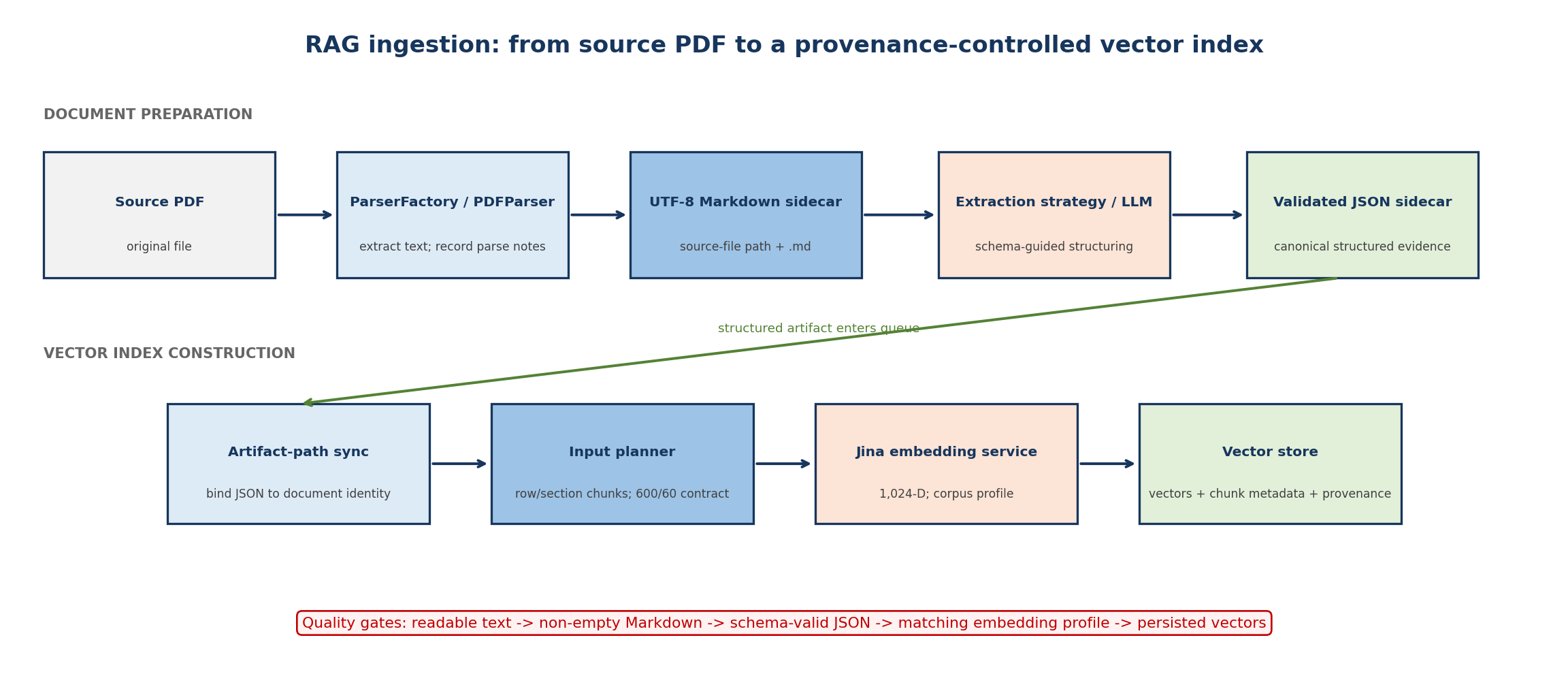
- PDF → Markdown → structured JSON
- Jina 1,024-D chunk embeddings
- 1,000 chunk candidates
- Aggregation to 60 documents
- Optional Qwen reranking to top 25
Strength hypothesis: paraphrase and distributed evidence. Counter-hypothesis: semantic drift, chunk loss, or candidate truncation.
Lucene
- Parsed and normalized text
- Language-specific index
- Authored syntax and field boosts
- Fuzzy/multilingual expansion
- SquareSimilarity, filters, top 100
Strength hypothesis: rare exact terms and phrases. Counter-hypothesis: expansion drift or weak paraphrase coverage.
Mathematical model
Equations expose assumptions
Implemented definitions, explanatory abstractions and admissible comparisons are kept distinct.
Diminishing returns for repeated terms; boilerplate can still accumulate evidence.
Rare terms gain weight; rare OCR errors may also dominate.
Requires an identical model, prefix, pooling, dimension and normalization contract.
Balances one strong passage with repeated evidence; 0.7/0.3 is configured, not estimated here.
Frozen-criteria quality, section mapping and skipped criteria remain alternative explanations.
The returned score is an ordering signal, not assumed to be a calibrated probability.
The reranker cannot recover a relevant document omitted before the 60-document pool.
A benchmark-case observation, not a universal model property.
An accounting identity, not a hardware-independent complexity result.
No raw-score shortcut.
SquareSimilarity, cosine, aggregation and reranker scores occupy different spaces. Direct engine comparison begins only after rankings are evaluated against the same judgments.
Model analysis
Capability is not benchmark evidence
Published specifications, local serving choices and observed outcomes are treated as separate evidence layers.
Bi-encoder
Jina v5 small retrieval
Corpus-scale reusable representations
Model/profilejina-embeddings-v5-text-small-retrieval / jina-v5-small-vllm
Pin the exact local snapshot and hash.
Published capability677M; 1,024-D; LAST; 32,768 context; Matryoshka
Capability is not CV-domain effectiveness evidence.
Local servicevLLM pooling; FP16; 8,192 tokens; GPU target 0.3
Backend, batching and contention were not ablated.
NormalizationResolved normalize=true; not explicit in startup pooler config
Verify the effective service/application path.
Chunking600 tokens / 60 overlap
Overlap protects boundaries but creates correlated candidates.
Query intentFind the most suitable job applicants for these requirements:
Prefix sensitivity is not isolated.
Cross-encoder
Qwen3 Reranker 4B
Bounded joint query–evidence scoring
Model/profileQwen3-Reranker-4B / no-instruction profile
An observed gain belongs to this checkpoint and pool.
Published capability4B; 32K; 100+ languages; optional instructions
Published breadth does not prove recruitment ranking quality.
Local serviceBF16; 8,192 tokens; GPU target 0.5
ROCm, vLLM, hardware and contention may affect results.
ArchitectureQwen3ForSequenceClassification; no/yes tokens; Jinja template
Template and override changes are model changes.
Candidate/output60 input documents / top 25
First-stage omissions are irreversible.
Section planner2,000-token chunk; 3,000 atomic; 8,000 sequence
Splitting and importance weights confound pure checkpoint effects.
Architecture critique.
A smaller bi-encoder followed by a larger bounded cross-encoder is computationally coherent, but coherence is not proof of optimality. Pool size, normalization, instruction choice, templates, splitting, another checkpoint, or a lexical–dense hybrid remain credible alternatives.
Critical analysis
What else could explain the pattern?
An academic report challenges causal stories even when the aggregate result supports the system.
May reflect the Qwen checkpoint, candidate composition, section formatting, or top-25 policy—not dense retrieval alone.
Required: pre-rerank rankings and candidate recall.May combine algorithmic efficiency with date-specific cache, host, database, queue and service conditions.
Required: repeated interleaved controlled runs.Changes scope and weights together; whole mode can require all selected section types.
Required: scope-only and weight-only ablations.Resolved normalization is true, while the startup pooler configuration does not state normalization explicitly.
Required: verify effective output norms and index provenance.Group sizes are 9, 13, 3 and 1. A one-case group cannot support a stable subgroup generalization.
Required: case distributions and broader samples.One measured repetition per case cannot estimate run-to-run reliability or tail latency stability.
Required: replicated runs with stage timing.Figure atlas
31 report figures
Method diagrams are separated from measured-result and diagnostic figures. Select any figure to enlarge it.
Showing 31 of 31 figures.
Validated deliverables
Download the complete evidence package
The web publication is an analytical companion. The Word report and Excel workbook remain the authoritative formatted deliverables.